

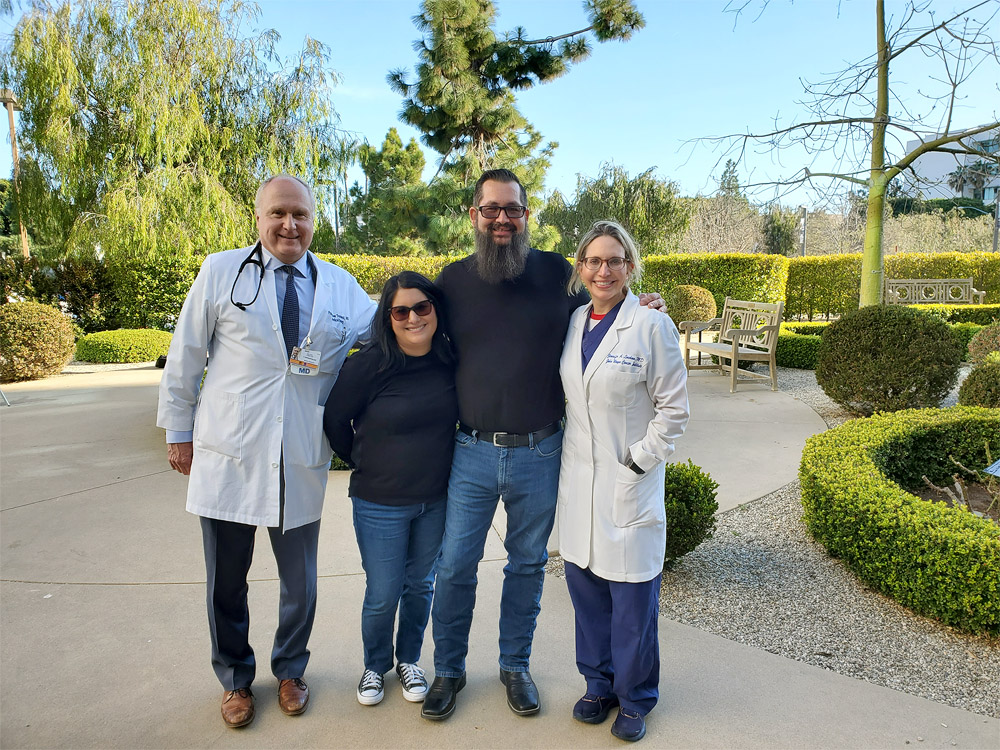
Andy and Theresa Luci’s Journey Through Stage IV Kidney Cancer
When Andy Luci was diagnosed with stage IV renal cell carcinoma at age 51, he and his wife, Theresa, faced an uncertain future. What began as abdominal discomfort led to an unexpected cancer diagnosis, extensive surgery, and years of treatment complicated by significant side effects. Through it all, Andy remained determined to be there for his family, supported by his wife, children, and the physicians who guided his care at Saint John’s Cancer Institute.
Andy and Theresa’s story is one of resilience, family, and the importance of finding a medical team you trust. After two years of changing treatments and difficult complications, Andy received news he once thought he might never hear: he was cancer-free.
What Is Stage IV Renal Cell Carcinoma?
In September 2019, Andy began experiencing abdominal discomfort that he initially thought might be related to kidney stones or gallbladder problems. An ultrasound revealed an abnormality that required further evaluation. His first physician suggested it might be a cyst.
“That’s what you want to hear, that it isn’t cancer,” Andy recalled.
At his mother’s behest, Andy sought a second opinion. Further evaluation at Saint John’s Cancer Institute led to a diagnosis of renal cell carcinoma (RCC), the most common type of kidney cancer.
Andy was 51 when he received his diagnosis. His care team included Jennifer Linehan, MD, a urologic oncologist and surgeon, and Przemyslaw Twardowski, MD, a medical oncologist specializing in genitourinary cancers.
Kidney cancer is often discovered incidentally during imaging performed for unrelated concerns. Unlike some other cancers, there is no routine blood or urine test that reliably screens the general population for kidney cancer. Imaging and further diagnostic evaluation are important when an abnormality is identified.
For Andy and Theresa, the transition from an uncertain imaging finding to a serious cancer diagnosis happened quickly.
“Everything happened so fast,” Theresa remembered.
Stage IV renal cell carcinoma means the cancer has spread beyond the kidney to other parts of the body. Before surgery, Andy understood that he had stage III disease. During his surgical evaluation, the extent of the cancer became clearer, and his diagnosis was subsequently described as stage IV.
Dr. Linehan performed a minimally invasive radical nephrectomy, removing the affected kidney, along with an adrenalectomy to remove the adrenal gland. According to Andy’s original account, the cancer had also spread to his pancreas, lung, and lymph nodes.
Because the disease extended beyond the original kidney tumor, surgery alone would not be sufficient to address all known cancer. His physicians recommended systemic treatment to target cancer cells elsewhere in the body.
Andy’s Journey Through Immunotherapy
Following surgery, Andy began combination immunotherapy with nivolumab (Opdivo) and ipilimumab (Yervoy), two immune checkpoint inhibitors used in the treatment of selected patients with advanced renal cell carcinoma.
These medications work by helping the immune system recognize and attack cancer cells. However, they can also cause the immune system to attack healthy tissue, resulting in inflammatory complications.
Andy experienced significant side effects. Following his initial combination immunotherapy, he developed pancreatitis and diabetes, requiring his treatment to be interrupted for approximately nine months.
Despite the complications, his cancer showed a meaningful response. Andy’s original account described tumors continuing to regress even while treatment was on hold.
His experience was particularly difficult physically. He developed painful symptoms affecting his hands and feet, which made walking difficult. For approximately one month, he relied on a wheelchair. He also experienced inflammation involving his liver and thyroid, requiring hospitalization, and needed insulin to manage diabetes.
Andy described the experience with a mixture of frustration and humor:
“For me, it wasn’t you might, it was you are going to get it. And I would get everything. If there was a side effect listed…I would always get the worst of it.”
His experience illustrates how differently patients can respond to cancer treatment. While immunotherapy can be effective for advanced kidney cancer, side effects and their severity vary from person to person.
A Treatment Plan That Continued to Evolve
As Andy’s treatment progressed, Dr. Twardowski continued evaluating his response and adjusting his medications according to both the cancer’s behavior and the complications he experienced.
His treatment eventually included pembrolizumab (Keytruda), another immune checkpoint inhibitor, and axitinib (Inlyta), a targeted therapy used in selected advanced kidney cancer treatment regimens.
Over approximately two years, Andy reported receiving about 30 immunotherapy infusions. He also experienced difficulties tolerating targeted therapy, requiring medication adjustments and close monitoring.
His treatment was far from straightforward. His physicians had to continually assess how his body was responding while monitoring the cancer and managing the consequences of treatment.
Andy appreciated the team’s continued involvement and communication throughout the process.
“It was always evolving according to what was happening to me. So, my treatment wasn’t kind of straightforward…yeah, it wasn’t fun or anything, but I always knew that my doctors, Dr. Twardowski and Dr. Linehan…were going to find out…what was going to happen next, and it always happened that way.”
Despite the challenges, Andy maintained his confidence in his physicians.
“I went through a lot, but I never felt like I was lost, or like, this is it now. I always knew that they would take care of it…I always bounced back.”
The Importance of a Personal Connection With Your Care Team
Throughout hospitalizations, medication changes, and difficult periods of recovery, Andy and Theresa developed close relationships with the professionals involved in his care.
Andy recalled being able to communicate directly with members of his treatment team, including physician assistant Anmol and Dr. Twardowski, as questions and concerns arose.
“They’d be texting me, and I’d be texting Anmol, the PA, and Dr. Twardowski. I didn’t expect that much personal care and treatment. In fact, Anmol would get mad for not contacting her. They were invested in my getting better,” Andy said.
Theresa described the same experience from her perspective as his wife and partner throughout treatment.
“They treat you like family here. They always treated us like we were the number one.”
For Andy and Theresa, these relationships helped them navigate the uncertainty of advanced cancer treatment. Having a team they trusted made a difficult and unpredictable experience feel more manageable.
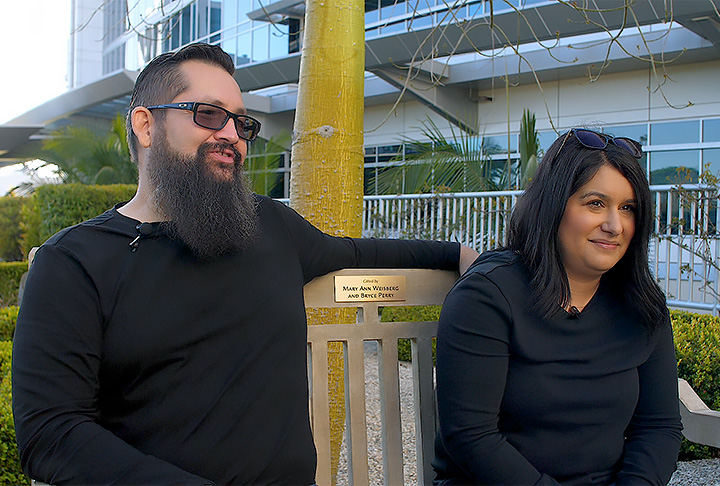
Andy and his wife Theresa share their story at Saint John’s Health Center.
“I’m one hundred percent sure, this is the place you want to be if you have cancer.”
– Andy Luci
Family, Hereditary Kidney Cancer, and the Motivation to Keep Going
Andy and Theresa have three children: two sons and a daughter. When the original story was published in 2023, their children were 25, 19, and 16.
As parents, they also had concerns about whether Andy’s diagnosis might affect their children’s future health. The family pursued genetic testing to investigate the possibility of hereditary kidney cancer.
Some kidney cancers are associated with inherited genetic syndromes, although many occur without an identifiable hereditary cause. Genetic counseling and testing can help determine whether a family may have an inherited risk.
For Andy and Theresa, the evaluation provided some reassurance during an already uncertain time.
Andy also recognized how much his children had contributed to his strength throughout treatment.
“All three of my children were there when I needed them. We’ve grown from this experience as a family,” he reflected.
His family was central to his motivation to continue through difficult treatments. When asked what affected him most about living with advanced cancer, Andy described the possibility of missing important milestones in his children’s lives.
“That’s the hardest part of all this. Because for me, not seeing my kids get married, grandkids…that’s what affected me.”
– Andy Luci
At the beginning of his treatment, Andy had even begun recording messages for his children to hear at future milestones, including their weddings.
“So, I think that’s the worst part. And when you’re at the beginning, when you’re sitting…I was making recordings for them, when they get married for stuff that I would miss. Now, I don’t get to miss that. So, the days are sweeter. I owe my life to Dr. Linehan, to Dr. Twardowski, and to everybody; to all of the staff here. I really could say if it weren’t for that team, I wouldn’t be here. So, I’m happy.”
An Experienced, Multidisciplinary Team
Looking back, Andy recognized the importance of his mother’s encouragement to seek a second opinion. What began as an uncertain imaging finding ultimately revealed an advanced cancer requiring surgery and systemic treatment.
His care involved the complementary expertise of two physicians. Dr. Linehan performed his kidney surgery, while Dr. Twardowski directed his systemic treatment and monitored his response through subsequent therapies.
Andy expressed his gratitude toward both physicians:
“Thank you for choosing the field you are in. Thank you for excelling, for basically being…for what I think, is the best in their field. Not just as doctors, but as people…They’re not just great at what they do, they are awesome people. They treat you as an equal. I’m happy to see them. I’m happy to do a 3-hour drive for my appointment. They basically saved my life.”
– Andy Luci
For Andy, the relationship extended beyond the clinical aspects of his care. He valued having physicians who listened, communicated, and continued working with him as his circumstances changed.
Multidisciplinary care can be particularly important for patients with advanced kidney cancer, whose treatment may involve surgery, medical oncology, management of treatment-related complications, and ongoing monitoring.
Learn more about Jennifer Linehan, MD, Przemyslaw Twardowski, MD, and the Urology and Urologic Oncology Center of Excellence.
Watch Andy and Theresa Share Their Kidney Cancer Journey
In their original patient interview, Andy and Theresa describe the shock of his diagnosis, the physical challenges of treatment, and the relationships that helped their family through an uncertain period.
Andy and Theresa Luci: Living Through Stage IV Renal Cell Carcinoma
Andy and Theresa Luci discuss kidney cancer, treatment complications, family support, and their experience with Dr. Jennifer Linehan and Dr. Przemyslaw Twardowski. Original patient interview, 2023.
December 8, 2022: News Andy Never Expected to Hear
After years of surgery, systemic treatment, complications, and uncertainty, Andy and Theresa received extraordinary news on December 8, 2022: Andy’s physicians told him that he was cancer-free.
For a man who had once prepared recordings for family milestones he feared missing, the news was almost impossible to absorb.
“I never thought I was going to hear that,” Andy recalled.
He did not describe an elaborate celebration. Instead, the news brought a profound sense of relief. The milestones he had looked forward to were still the same ones that had motivated him through treatment: watching his children get married and, one day, meeting his grandchildren.
When Andy shared his story in March 2023, he reported being approximately four months cancer-free. This reflects his reported health status at the time of the interview, rather than a statement about his current health.
For patients with advanced kidney cancer, a complete response or the absence of detectable disease is encouraging, but continued follow-up remains important.
Andy’s Advice: Living the Best Life He Could
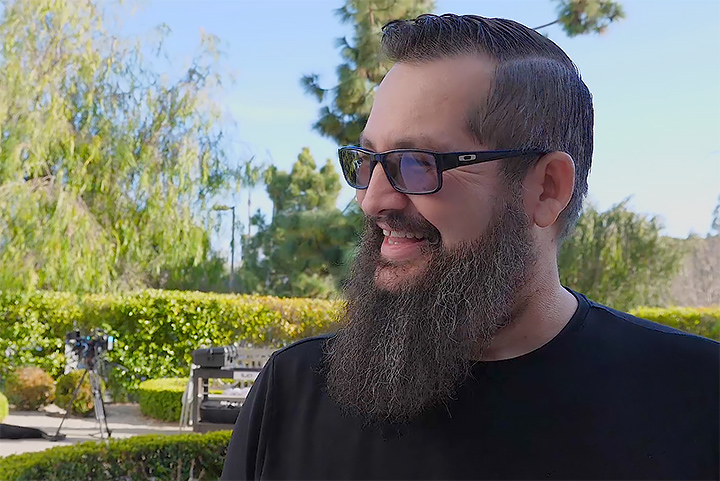
When reflecting on what helped him navigate his diagnosis, Andy emphasized perspective, optimism, and his decision to continue living as fully as possible.
His advice came from personal experience:
- My perspective was to be optimistic about the whole situation. To live as if I didn’t have cancer. I had the luxury of having a great team. Whatever happens, if I pass in a month or survive, I’m going to live the best life I can. I didn’t want anyone to know, other than my family that I had cancer.
- If someone has it, at the beginning it’s horrible, it’s the worst news you can get. For me, I came to peace with it. I asked myself, what do I have to do now?
Andy’s journey was supported by many people: his mother, whose encouragement led him to seek another opinion; his wife, who shared the uncertainty of treatment; their three children; and the medical professionals who helped him navigate the complications of advanced cancer care.
Looking back, Andy captured the importance of that support in a few words:
“They are the reason I was strong.”
– Andy Luci
Living Beyond a Stage IV Kidney Cancer Diagnosis
Andy’s experience demonstrates the uncertainty of advanced kidney cancer and the importance of individualized treatment and coordinated care. His journey involved extensive surgery, immunotherapy, significant treatment complications, and multiple adjustments to his medications. Through it all, his family and medical team remained central to his experience.
Patients and families seeking information about renal cell carcinoma can learn more through Saint John’s Cancer Institute’s Kidney Cancer Diagnosis and Treatment resources and the Urology and Urologic Oncology Center of Excellence. Treatment planning is individualized according to each patient’s diagnosis, health, and goals.
Sources & Further Reading
- Saint John’s Cancer Institute — Kidney Cancer
- National Cancer Institute — Renal Cell Cancer Treatment (Patient Version)
- National Cancer Institute — Hereditary Kidney Cancer Syndromes
- European Association of Urology — Renal Cell Carcinoma Disease Management
- Saint John’s Cancer Institute — Urology and Urologic Oncology Center of Excellence