


Changing the Future of Cancer Care
New research led by Kodai Abe, MD, Ph.D., has identified a promising biomarker that may one day help physicians better monitor patients with intrahepatic cholangiocarcinoma (iCCA), an aggressive form of bile duct cancer with limited treatment options and a high risk of recurrence.
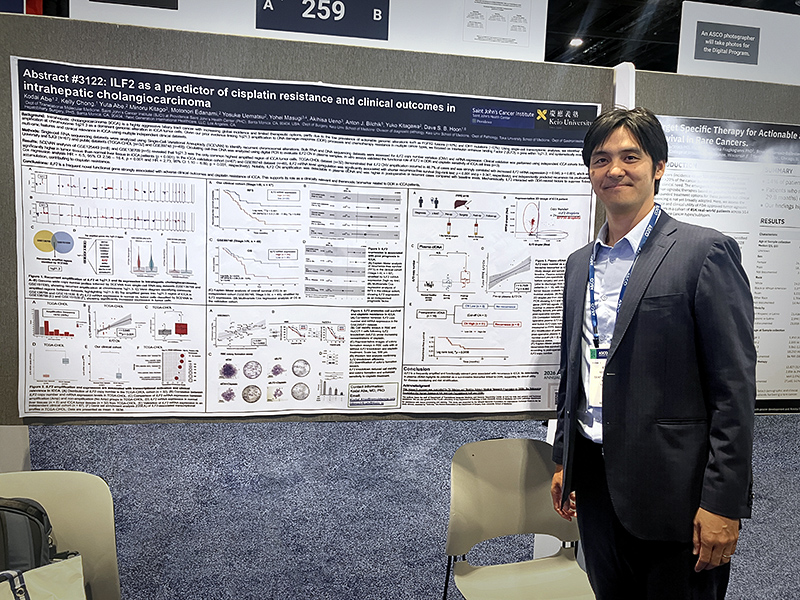
Working in collaboration with investigators from Keio University in Tokyo, Japan, Dr. Kodai Abe and colleagues examined the role of a gene known as ILF2, which appears to help cancer cells survive by maintaining genomic stability. The team found that tumors with increased ILF2 activity were associated with more aggressive disease and poorer outcomes. Just as importantly, researchers demonstrated that ILF2 alterations could be detected in circulating cell-free DNA—tiny fragments of tumor DNA found in a patient’s bloodstream—creating the potential for a simple blood test to help monitor patients after surgery.
The elevation of ILF2 can be explained by an increased number of gene copies in the genome of cancer cells. Functionally, ILF2 helps cancer cells survive under genotoxic stress conditions. The team found that elevated ILF2 expression in iCCA tumors was associated with more aggressive disease and poorer outcomes. Just as importantly, researchers demonstrated that ILF2 genomic alterations could be detected in circulating cell-free DNA—tiny fragments of tumor DNA found in a patient’s bloodstream—creating the potential for a simple blood test to help monitor recurrence in patients with iCCA after surgery.
For patients, the implications could be significant. Today, individuals treated for intrahepatic cholangiocarcinoma often require ongoing imaging scans and clinical follow-up to watch for signs that the cancer has returned. The ability to identify molecular changes through a blood sample could one day help physicians detect recurrence earlier, better understand an individual’s risk, and tailor follow-up care based on the unique biology of each patient’s tumor. Such advances could move cancer surveillance beyond imaging alone and toward a more personalized approach to care using minimally invasive tests.
We are incredibly proud of the dedication and collaboration that made this research possible. Discoveries like these bring us closer to a future where we can more precisely monitor patients after surgery, identify those at highest risk for recurrence, and develop more personalized treatment strategies that improve outcomes.
– Anton Bilchik, MD, FACS
The research Dr. Abe conducted also identified ILF2 as a potential therapeutic target, suggesting future opportunities to develop treatments that make cancer cells more vulnerable to existing therapies which has the potential to improve outcomes for patients. While additional studies are needed before these findings can be incorporated into routine clinical practice, the work represents an important step toward precision oncology approaches that use molecular information to guide patient care.
“This study highlights the outstanding work being conducted by Dr. Abe and our translational research team to better understand the biology of aggressive cancers and identify opportunities to improve patient care,” said Dr. Anton Bilchik, Professor of Surgical Oncology, Chief of General Surgery, Director of the Gastrointestinal and Hepatobiliary Program, and Director of the Gastrointestinal Research Program at Saint John’s Cancer Institute and co-author of the study.
“This type of research demonstrates the power of connecting basic and translational discoveries with real-world clinical challenges,” said Dr. Matias A. Bustos, Head of Translational Research at Saint John’s Cancer Institute. “By identifying biomarkers that may help predict recurrence and guide treatment decisions, we are building the foundation for more personalized cancer care. As we continue to expand our laboratory and translational research capabilities, we are creating new opportunities to accelerate discoveries that can directly benefit patients and support the development of next-generation diagnostic and therapeutic approaches.”
Funding was provided by CORI Foundation and the Adelson Medical Research Foundation (AMRF).
Research Details
ILF2 amplification promotes genome instability and enables cfDNA-based postoperative monitoring of patients with intrahepatic cholangiocarcinoma
Contributors: Kodai Abe, Kelly Chong, Yuta Abe, Minoru Kitago, Motonori Edanami, Yosuke Uematsu, Yohei Masugi, Akihisa Ueno, Yuko Kitagawa, Jason Mooney, Anton J. Bilchik, Matias A. Bustos, Dave S. B. Hoon
Intrahepatic cholangiocarcinoma (iCCA) is an aggressive malignancy with limited therapeutic options and few clinically useful biomarkers. In this study, we identify that ILF2 downregulation decreased tumor viability and cisplatin treatment responses, while it increased DNA damage and R-loop accumulation in iCCA cell lines. In vitro, ILF2 interacts with the RNA helicase DXH9, a critical factor associated with R-loop unwinding. Importantly, single-cell transcriptomic and copy number analyses revealed recurrent 1q21.3 amplification involving ILF2, suggesting genomic activation in a clinically relevant subset of tumors. Furthermore, ILF2 amplification was detectable in pre- and postoperative cell-free DNA samples from iCCA patients, supporting its potential utility as a minimally invasive biomarker for recurrence. These findings provide translational rationale for the development of ILF2-based molecular stratification strategies and suggest that targeting the ILF2/DHX9 function in R-loop regulation may represent a therapeutic vulnerability in iCCA.
Abstract
ILF2 as a predictor of cisplatin resistance and clinical outcomes in intrahepatic cholangiocarcinoma.
https://ascopubs.org/doi/10.1200/JCO.2026.44.16_suppl.3122
Results: SCEVAN identified recurrent amplification of chromosome 1q21.3 in malignant iCCA cells, nominating ILF2 as a candidate gene. ILF2 depletion increased γH2AX accumulation and enhanced sensitivity to cisplatin, indicating impaired DNA damage responses. Mechanistically, ILF2 functionally cooperated with the RNA helicase DHX9, and combined depletion experiments suggested that both proteins operate within a shared pathway regulating R-loop–associated DNA damage. Clinically, high ILF2/DHX9 expression was associated with poor prognosis in iCCA patients. Furthermore, ILF2 copy number amplification was detectable in cell-free DNA, and elevated postoperative ILF2 copy number was associated with increased recurrence risk and shorter recurrence-free survival.
Conclusions: Our findings identify ILF2 as a clinically relevant mediator linking 1q21.3 amplification to increased DNA damage and reduced therapeutic responses in iCCA. The ILF2–DHX9 axis may represent a previously unrecognized mechanism associated with R-loop–related DNA damage, while cell-free ILF2 copy number analysis offers potential utility as a minimally invasive biomarker for monitoring postoperative recurrence.