

A New Treatment That Was Worth the Wait
In 2019, after five years of monitoring a benign thyroid nodule first diagnosed in 2014, Scott Millward went to see a specialist at USC Keck School of Medicine. His nodule had grown to approximately 5.5 centimeters and was visibly protruding from his neck. “It was golf ball-sized,” Scott recalls in his testimonial.
The specialist discussed treatment options and recommended surgery to remove his thyroid gland. Scott wanted to find an alternative to thyroidectomy because he preferred to preserve his thyroid whenever possible. Patients who undergo total thyroidectomy require lifelong thyroid hormone replacement, while patients who have only part of the thyroid removed may or may not need hormone medication.
Why Treat a Benign Thyroid Nodule?
A benign thyroid nodule is a noncancerous growth within the thyroid gland. Many thyroid nodules cause no symptoms and can be monitored without treatment. Others enlarge over time, causing visible changes to the neck, difficulty swallowing, pressure, discomfort, or occasionally breathing difficulties.
Thyroid nodules can be solid, fluid-filled, or contain both solid and cystic components. They differ from a goiter, which refers to an enlargement of the thyroid gland and may involve one or several nodules. Goiters can develop for various reasons, including iodine deficiency, autoimmune thyroid disease, and other thyroid conditions.
Whether a benign thyroid nodule requires treatment depends on its size, growth, ultrasound appearance, associated symptoms, cosmetic concerns, thyroid function, and the patient’s preferences.
Possible Symptoms of Benign Thyroid Nodules
- Difficulty swallowing or a feeling of pressure in the neck
- Breathing difficulty when a large nodule compresses nearby structures
- A visible or palpable lump in the neck
- Neck discomfort or fullness
- Changes in voice or other symptoms requiring further evaluation
For many years, surgery was an established treatment for large symptomatic thyroid nodules. Observation remained appropriate for nodules that were benign and not causing problems. More recently, minimally invasive procedures such as radiofrequency ablation (RFA) have become increasingly available in the United States as alternatives for selected patients.
Scott was particularly motivated to preserve his thyroid. “You need it. It shortens your life if you take it out,” Scott suggested.
His concern about losing the thyroid gland was important to his treatment decision. However, total thyroidectomy does not inherently shorten a person’s life. When surgery is medically necessary, lifelong thyroid hormone replacement and appropriate follow-up can allow patients to maintain normal thyroid function and quality of life.
Scott first learned he had a benign thyroid nodule during a routine examination at age 41. Because he had no noticeable symptoms or visible neck changes at that time, he chose to monitor it.
I decided to monitor it, I was not anxious to take anything out of my body proactively if I could help it.
– Scott Millward
Over time, however, Scott began experiencing symptoms that affected his daily activities. He described fatigue during exercise, reduced stamina, and an increasingly noticeable bulge in his neck that he felt was interfering with his breathing.
“I was mentally tired from fighting it. After losing my father in 2020, I reevaluated what was important, and took this situation more seriously.”
Scott began exploring treatment options that might relieve his symptoms without requiring removal of the thyroid gland.
Finding an Alternative to Thyroid Surgery
Scott’s search for radiofrequency ablation involved two challenges: finding a physician experienced in the procedure and obtaining insurance coverage.
Thyroid RFA had been performed internationally for years before becoming more widely available in the United States. As more specialists introduced the technique, patients like Scott gained another potential treatment option for appropriately evaluated benign thyroid nodules.
Insurance coverage also remained a practical obstacle. Scott spent considerable time seeking approval before he could proceed with the procedure.
After his insurance agreed to cover treatment, he initially pursued care at UCLA. However, he decided not to continue there because the process did not meet his expectations.
“The process was cumbersome and self-directed.”
Scott subsequently chose to receive treatment with Melanie Goldfarb, MD, at Providence Saint John’s Health Center in Santa Monica, California. He was 49 years old at the time.
[Dr. Goldfarb] made me feel at ease. I felt so confident with her skill. I felt like it was a team effort. I decided to go with Dr. Goldfarb, and BOY what a good decision that ended up being!
– Scott Millward
Listen to Scott Recount His Journey With Thyroid Radiofrequency Ablation
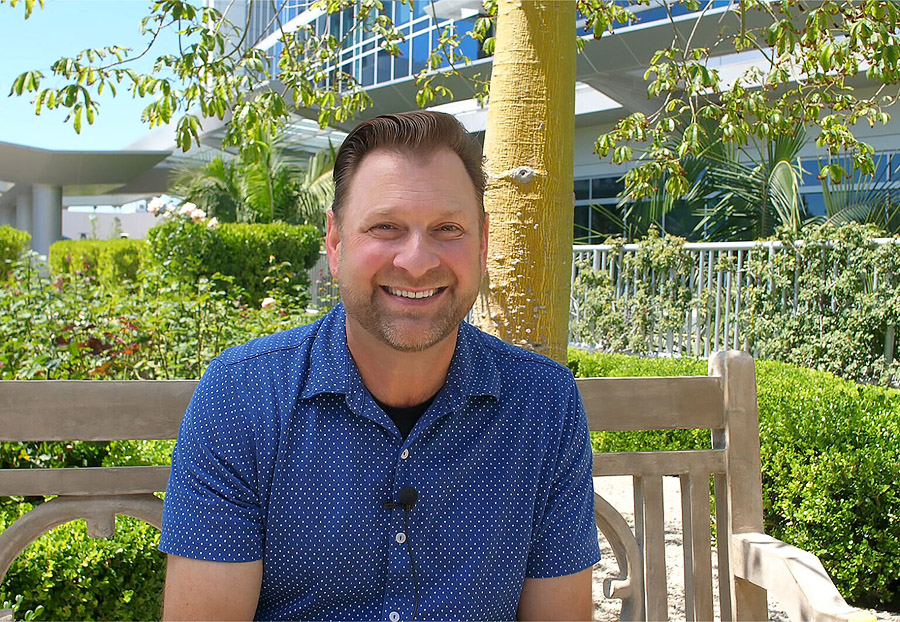
Scott Millward speaks with Saint John’s Cancer Institute staff in the Rose Gardens at Providence Saint John’s Health Center.
Scott’s Thyroid RFA Treatment and Recovery
Thyroid radiofrequency ablation is a minimally invasive outpatient procedure that uses ultrasound guidance to deliver controlled thermal energy into a thyroid nodule through a thin probe. The treatment destroys targeted nodule tissue without surgically removing the thyroid gland.
Over time, the body gradually reabsorbs the treated tissue, allowing the nodule to shrink. This can reduce pressure symptoms, visible enlargement, and other concerns associated with benign thyroid nodules.
Because RFA preserves most normal thyroid tissue, many patients maintain normal thyroid function and do not require thyroid hormone replacement after treatment. However, treatment selection and outcomes depend on the individual patient’s circumstances.
Learn more about Thyroid Radiofrequency Ablation for Benign Thyroid Nodules.
A Nodule Reduction of More Than 90 Percent
At his 10-month follow-up visit, Scott learned that his benign thyroid nodule had decreased in volume by more than 90 percent after treatment.
Dr. Goldfarb had previously explained that a reduction of approximately 50 to 60 percent might be expected, so Scott’s reported result exceeded those expectations.
This was a particularly meaningful outcome for Scott after years of monitoring the nodule and searching for an alternative to surgery. His result reflects an individual treatment response and should not be interpreted as the amount of shrinkage that every patient can expect from RFA.
Importantly, the reported reduction refers to the treated nodule’s volume, not the size of Scott’s thyroid gland.
Recovery and Relief From Symptoms
Scott described his recovery as straightforward. He used a cooling collar on his neck during the first 24 hours following treatment and reported little difficulty returning to his usual activities.
He also noticed an improvement in how he felt during physical activity. Before treatment, he had not fully appreciated how much discomfort and pressure the enlarged nodule was causing.
“Almost overnight, I felt fitter and that was relief enough,” Scott mentions.
Although Scott reported feeling better quickly, RFA generally produces a gradual reduction in nodule size over weeks and months rather than immediately removing the nodule. Some patients experience early relief from symptoms, while others improve more gradually.
Scott’s Advice to Other Patients
Scott encourages patients to understand their options and participate actively in treatment decisions.
“If you are patient, do your research, and if you advocate for yourself, then ultimately you are going to get treatment that will work for you.”
Self-advocacy was an important part of Scott’s experience. He sought different opinions, explored available technologies, addressed insurance requirements, and ultimately chose a physician and treatment approach with which he felt comfortable.
[Dr. Goldfarb] Your optimism and enthusiasm made me feel comfortable at a time of significant stress for me, and what can I say, your work is pretty good, and I’m living proof.
– Scott Millward
Understanding Thyroid Radiofrequency Ablation
Scott’s story illustrates how a large benign thyroid nodule can affect daily life and how minimally invasive treatment may provide an alternative to surgery for some patients. The following information explains the eligibility criteria, treatment process, expected results, and follow-up recommendations for thyroid RFA.
Who Is a Candidate for Thyroid RFA?
According to the American Thyroid Association, thermal ablation is most appropriate for patients with benign thyroid nodules that cause pressure symptoms, swallowing difficulties, visible enlargement, or other significant cosmetic concerns. Certain autonomously functioning thyroid nodules that produce excess thyroid hormone may also be considered for treatment.
Not every benign thyroid nodule requires intervention. Small nodules without symptoms can often be observed with periodic clinical evaluation and ultrasound when appropriate.
Before recommending RFA, physicians evaluate the nodule’s size, ultrasound characteristics, location, biopsy findings, symptoms, and relationship to nearby structures, including the windpipe, esophagus, blood vessels, and nerves.
Large nodules may require more than one treatment session, and surgery may be more appropriate in some circumstances. Patients should discuss the expected benefits, limitations, and alternatives with a clinician experienced in thyroid nodule management.
How Many Benign Biopsies Are Required?
Establishing that a thyroid nodule is benign is an important safety requirement before performing RFA. Unlike surgical removal, ablation does not provide an intact tissue specimen for comprehensive pathological examination.
The American Thyroid Association generally recommends two benign biopsy results before thermal ablation. However, a single benign biopsy may be sufficient for certain nodules with very low suspicion on ultrasound or for selected autonomously functioning nodules with appropriately reassuring findings.
Individual treatment decisions depend on the ultrasound risk category, biopsy results, thyroid function, clinical history, and any features that raise concern about malignancy.
Patients with suspicious findings or an uncertain diagnosis may need additional testing or a different treatment approach before ablation can be considered.
What Happens During Thyroid RFA?
Thyroid RFA is generally performed on an outpatient basis using local anesthesia and real-time ultrasound guidance. A physician inserts a thin probe into the nodule and applies controlled radiofrequency energy to heat and destroy targeted tissue.
The physician moves the treatment tip through different areas of the nodule while monitoring nearby structures with ultrasound. This approach aims to reduce the nodule while preserving surrounding healthy tissue.
Because the procedure does not involve surgical removal of the thyroid gland, patients typically avoid a neck incision and general anesthesia. Nevertheless, RFA is an invasive medical procedure with potential complications, including pain, swelling, bleeding, voice changes, and injury to nearby tissues.
Patients should be informed about these risks and the possibility that additional treatment may be necessary.
How Much Can a Benign Thyroid Nodule Shrink?
Clinical studies have shown substantial reductions in benign thyroid nodule volume after RFA. The amount of shrinkage varies according to the nodule’s initial size, composition, blood supply, location, and the treatment performed.
Many patients experience meaningful reduction during the first 6 to 12 months, with further improvement possible over time. Some nodules may shrink by more than 80 or 90 percent, but those results are not guaranteed.
Larger nodules may shrink less completely or require additional sessions. Follow-up ultrasound helps physicians measure the treated nodule and determine whether the response is sufficient.
Scott’s reported reduction of more than 90 percent at 10 months was an excellent individual result. It should be considered in the context of his particular nodule and treatment history rather than as a standard outcome for all patients.
Does RFA Preserve Thyroid Function?
One potential benefit of RFA is preservation of normal thyroid tissue. Because the procedure targets the nodule rather than removing the gland, many patients continue producing sufficient thyroid hormone after treatment.
By comparison, patients undergoing total thyroidectomy require lifelong thyroid hormone replacement. Patients undergoing thyroid lobectomy may retain sufficient thyroid function, although some require medication.
Thyroid function should be evaluated before treatment and monitored afterward when indicated, particularly in patients with preexisting thyroid disorders or autonomously functioning nodules.
The goal is to select the treatment that best addresses the patient’s symptoms and diagnosis while balancing benefits, risks, and long-term follow-up needs.
Can a Thyroid Nodule Grow Again After RFA?
Although RFA can produce durable reductions in benign thyroid nodule size, some nodules may regrow or develop additional symptoms over time. Continued growth can occur when viable nodule tissue remains after treatment.
Follow-up may involve ultrasound examinations, evaluation of symptoms, and thyroid function testing when appropriate. If the nodule remains symptomatic, regrows, or develops concerning features, repeat RFA, additional diagnostic testing, or surgery may be considered.
Patients should understand that thyroid RFA reduces nodule tissue but does not necessarily eliminate the nodule completely or remove the need for future monitoring.
Is Thyroid RFA Covered by Insurance?
Insurance coverage for thyroid radiofrequency ablation varies by health plan, medical policy, diagnosis, and documentation of medical necessity.
Some insurers may cover RFA for eligible symptomatic benign thyroid nodules when their specific requirements are met. Others may impose additional restrictions or consider certain uses investigational.
Patients considering treatment should verify coverage, authorization requirements, and potential out-of-pocket expenses with their insurer and treatment provider before scheduling the procedure.
Scott’s experience illustrates how insurance authorization can influence a patient’s ability to access an otherwise appropriate treatment option.
Thyroid Nodule Care at Saint John’s
Scott Millward’s experience demonstrates the importance of understanding treatment options for symptomatic benign thyroid nodules. After years of monitoring his condition and seeking an alternative to surgery, he found an approach that aligned with his preference to preserve his thyroid and provided meaningful relief from his symptoms.
Learn more about Thyroid Radiofrequency Ablation at Saint John’s Cancer Institute, including patient eligibility, treatment, recovery, and follow-up. Patients can also explore the Center for Endocrine Tumors and Disorders and the care provided by Melanie Goldfarb, MD, and the endocrine team.
Sources & Further Reading
- American Thyroid Association — General Principles for Safe Ablation of Benign Thyroid Nodules (2023)
- American Thyroid Association — Thyroid Nodules
- Saint John’s Cancer Institute — Thyroid Radiofrequency Ablation
- Saint John’s Cancer Institute — Center for Endocrine Tumors and Disorders