

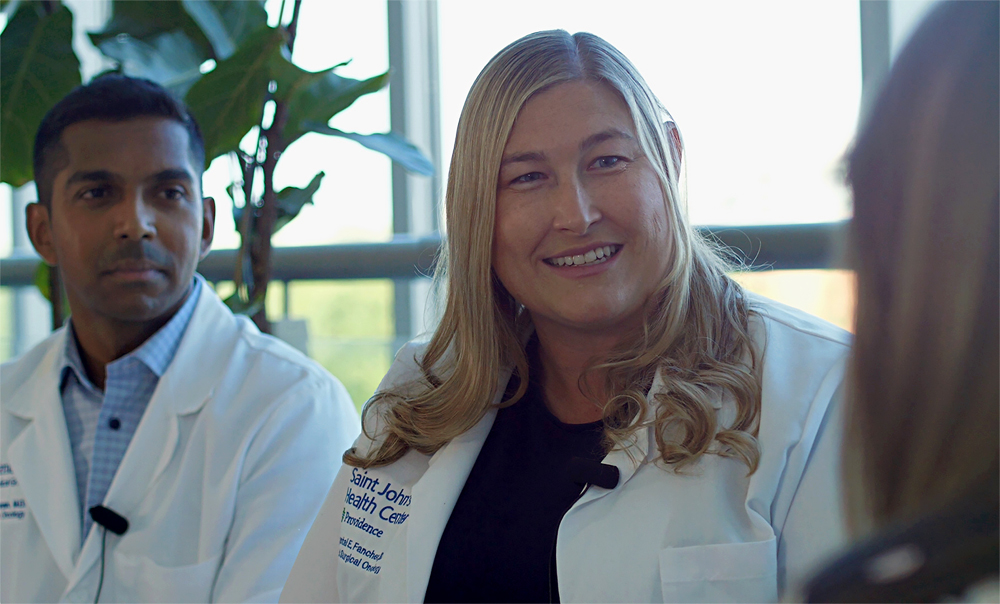
Two Independant Cancer Growths Found at The Same Time, No Known Risk Factors, and Not Genetically Linked: One Thrivor

Maria “Cristina” Torres, 51 at the time of her interview, is a mother of four: adult triplet sons and a teenage daughter. In just a few months, she faced two independent cancer diagnoses—ductal carcinoma in situ (DCIS) in her breast and stage IA renal cell carcinoma in her kidney. Her journey brought together specialists from the Roy and Patricia Disney Family Cancer Center in Burbank and Saint John’s Cancer Institute in Santa Monica.
At first, Cristina wanted to keep her diagnoses private. She was concerned about how the news would affect her family and preferred to manage much of the uncertainty herself. But as her treatment progressed, the support of her physicians, family, and friends became an important part of her experience.
She reflected on the emotional challenges of facing two cancers:
“The mental part has been the hardest part. Your doctors, your family, everyone around you, my friends, the support is what takes you through, because it’s hard, it’s very hard.”
What began with an abnormal routine mammogram eventually led to the discovery of an unrelated kidney tumor. Through breast surgery, radiation, robotic kidney surgery, and recovery, Cristina wrestled with a question that did not have a simple answer: Why had she developed two different cancers when her genetic testing had not identified an explanation?
“You don’t know if it’s what you eat, how much you weigh, if it’s something you did do, or didn’t do. That’s what’s scary about the whole thing…the mental is more worried it’s somewhere else,” Cristina explains.
Her experience underscores the uncertainty that can accompany a cancer diagnosis. Most cancers arise through a combination of biological and other influences that cannot always be traced to an identifiable cause. A negative hereditary cancer test does not establish that a cancer has no risk factors, nor does it mean that a patient caused the disease through a particular behavior.
At the time of her original interview, Cristina was celebrating the completion of treatment and reported being cancer-free after approximately six months. That milestone reflected her personal experience, while ongoing follow-up remained an important part of care.
“I love all three of my doctors. They’re amazing; you feel like they care.”
– Cristina Torres
Two Cancer Centers, One Collaborative Treatment Plan
Cristina received care through two Providence cancer programs: the Roy and Patricia Disney Family Cancer Center at Providence Saint Joseph Medical Center in Burbank and Saint John’s Cancer Institute at Providence Saint John’s Health Center in Santa Monica.
Her treatment journey crossed the 405 freeway, connecting physicians, clinical services, and surgical resources at the two facilities. The collaboration allowed specialists to coordinate treatment for two distinct cancers rather than managing each diagnosis without consideration of the other.
The Breast Cancer Diagnosis Began With a Routine Mammogram
In late October 2023, Cristina underwent a routine screening mammogram in Santa Clarita, California. The examination identified a suspicious breast abnormality, prompting additional evaluation and biopsy.
She was diagnosed with ductal carcinoma in situ (DCIS), also known as stage 0 breast cancer. DCIS develops when abnormal cells are confined to the breast ducts and have not invaded surrounding breast tissue.
Although DCIS is noninvasive, it requires individualized clinical assessment because some untreated lesions can progress to invasive breast cancer. Treatment recommendations depend on the extent and grade of the findings, other clinical factors, and patient preferences.
Cristina was referred to specialists at the Disney Family Cancer Center in Burbank. While waiting for additional appointments, she underwent genetic evaluation as part of her care.
The genetic testing did not identify a known inherited explanation for her diagnoses. However, hereditary cancer testing cannot identify every possible cause of cancer, and some patients develop more than one malignancy without a detectable inherited cancer-predisposing variant.
With an early, noninvasive breast diagnosis, Cristina had an opportunity to consider breast-conserving treatment options.
Breast-Conserving Surgery With Dr. Crystal Fancher
Cristina chose a lumpectomy incorporating oncoplastic surgery, performed by Crystal Fancher, MD, FACS, a breast surgical oncologist associated with the Margie Petersen Breast Center at Saint John’s and the Disney Family Cancer Center in Burbank.
Her procedure combined removal of the breast abnormality with bilateral breast reduction. The approach addressed her cancer treatment while also providing a change in breast size and shape that she had wanted for years.
For Cristina, that combination introduced an unexpected personal benefit during an otherwise difficult experience: she was able to consider a cosmetic change she had long desired while undergoing surgery for a condition she never wanted.
Oncoplastic breast surgery combines cancer removal with reconstructive techniques, which may include rearranging breast tissue or performing a breast reduction. When appropriate, these methods can help preserve breast shape after the removal of a tumor or other abnormal tissue.
The procedure must still achieve the required cancer treatment goals, including appropriate surgical margins. Oncoplastic techniques are available through various breast surgery programs and are not limited to a particular geographic area.
Following surgery, Cristina received external-beam radiation therapy as part of her breast treatment.
Learn more about Breast-Conserving Surgery and Oncoplastic Techniques through the Margie Petersen Breast Center.
Why Radiation May Follow Lumpectomy for DCIS
For many patients with DCIS treated by lumpectomy, radiation therapy is recommended to reduce the risk of cancer returning in the same breast, including both recurrent DCIS and invasive cancer.
However, radiation is not required for every patient with DCIS. Decisions depend on factors such as age, lesion size, grade, surgical margins, recurrence risk, and preferences after discussion of the expected benefits and potential side effects.
Radiation may be delivered using different techniques and schedules, depending on the clinical findings and current recommendations.
Cristina’s breast-conserving surgery and radiation were selected for her particular diagnosis. Other patients may receive different treatment recommendations.
Explore Breast Radiation Therapy and the role of radiation following breast-conserving surgery.
A Second Cancer Discovered During Cristina’s Breast Cancer Care
Just as Cristina was moving through treatment for DCIS, another unexpected finding emerged.
A CT scan obtained during her breast cancer care revealed a suspicious mass in her right kidney. The discovery led to further evaluation and a diagnosis of stage IA renal cell carcinoma in early February 2024.
“Just as I ended one treatment, I had to start all over,” Cristina recalled.
The kidney cancer was a separate primary malignancy, not breast cancer that had spread to the kidney. This distinction was central to understanding her diagnosis and selecting the appropriate surgical treatment.
What Is Stage IA Renal Cell Carcinoma?
Renal cell carcinoma is the most common type of kidney cancer in adults. It arises from cells within the kidney and includes several biological subtypes.
Stage IA renal cell carcinoma describes a tumor measuring 4 centimeters or less that remains confined to the kidney, with no evidence of spread to regional lymph nodes or distant sites.
Some kidney cancers cause symptoms such as blood in the urine or persistent flank pain, while others are discovered incidentally during imaging performed for unrelated medical reasons. Cristina’s kidney tumor was found in this manner.
Not all kidney tumors are cancerous, and not all kidney cancers are aggressive. Their behavior depends on tumor size, subtype, grade, and other findings.
Additional imaging and, in selected circumstances, biopsy or surgical pathology help specialists determine whether a kidney mass requires monitoring, surgery, or another approach.
Learn more about Kidney Cancer: Diagnosis, Stages, and Treatment through the Urologic Oncology Center of Excellence.
Robotic Partial Nephrectomy With Dr. Ramkishen Narayanan
With her kidney cancer confined to the organ, Cristina underwent a robotic-assisted partial nephrectomy performed by Ramkishen Narayanan, MD, a urologic surgical oncologist, at Providence Saint John’s Health Center in Santa Monica in late March 2024.
According to Cristina’s original account, approximately 25 percent of her right kidney was removed during the operation.
A partial nephrectomy removes the kidney tumor along with an appropriate amount of surrounding tissue while preserving as much healthy kidney tissue as safely possible.
For selected localized kidney cancers, partial nephrectomy offers an opportunity to treat the tumor while maintaining kidney function. The amount of tissue removed depends on the location, size, and complexity of the mass.
Dr. Narayanan used the da Vinci robotic surgical system, which allows the surgeon to control specialized instruments through small incisions. Robotic assistance can support precise dissection and reconstruction in appropriately selected cases, although it does not eliminate the risks associated with surgery.
Joshua Gottlieb, MD, then a fellow in urologic oncology at Saint John’s Cancer Institute, assisted Dr. Narayanan with Cristina’s procedure.
Reflecting on her recovery shortly after the operation, Cristina shared:
“I feel great right now, and it’s a month after…not even a month after.”
– Cristina Torres
Her recovery experience reflects the treatment and circumstances she described during the 2024 interview. Recovery time and surgical outcomes vary among patients.
Why Preserving Kidney Function Matters
When a kidney tumor is localized and technically suitable for partial nephrectomy, preserving healthy kidney tissue can help maintain long-term kidney function.
This is particularly important for patients with existing kidney disease, reduced kidney function, conditions affecting the other kidney, or other risk factors for future kidney problems.
Not every renal tumor can be treated with partial nephrectomy. Alternatives may include active surveillance, ablation, or removal of the entire kidney, depending on tumor characteristics and patient factors.
Learn more about Partial Nephrectomy and Other Kidney Cancer Treatments.
Watch Cristina Torres Speak With Her Breast and Kidney Cancer Surgeons
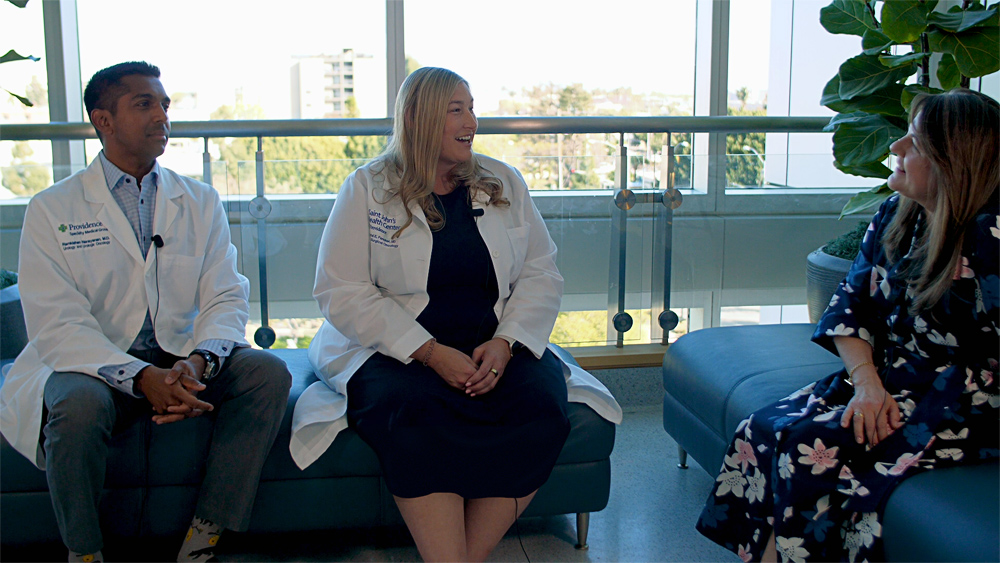
One of the most meaningful aspects of Cristina’s story is the opportunity to hear her discuss treatment alongside the two surgeons involved in her care.
In this original interview at Providence Saint John’s Health Center, Cristina sits with Crystal Fancher, MD, and Ramkishen Narayanan, MD. Together, they explain how her breast and kidney diagnoses unfolded, what the surgical treatments involved, and why collaboration across the Burbank and Santa Monica cancer programs was important.
For Cristina, the conversation also provides an opportunity to reflect on the reassurance she felt from her physicians and the emotional experience of facing a second cancer just as she was completing treatment for the first.
Dr. Fancher and Dr. Narayanan Interview Cristina Torres
Crystal Fancher, MD, and Ramkishen Narayanan, MD, speak with Maria “Cristina” Torres about the treatment of her independent breast and kidney cancers at Providence Saint John’s Health Center.
What Are Synchronous Primary Cancers?
When two distinct primary cancers are diagnosed in the same person within a relatively short period, they may be described as synchronous primary malignancies.
The term is used differently across some research studies and cancer registry systems. Many publications use a six-month interval between diagnoses, while others apply different timeframes or definitions.
Cristina’s DCIS was diagnosed in October 2023 and her kidney cancer was identified in February 2024, placing the diagnoses within a commonly used synchronous cancer interval.
How Is a Second Primary Cancer Different From Metastatic Disease?
A separate primary cancer develops independently from the first. Metastatic cancer occurs when cells from an original malignancy spread to another part of the body.
These situations may require very different treatment approaches. For example, an isolated renal cell carcinoma can sometimes be treated with surgery alone, while cancer that has metastasized from another organ generally requires treatment directed at the original cancer’s biology and extent.
Physicians consider imaging, pathology, tumor characteristics, and the clinical history to distinguish a new primary tumor from a metastasis.
In Cristina’s case, further evaluation established that her kidney cancer was unrelated to the noninvasive breast cancer identified earlier.
DCIS, by definition, has not invaded surrounding breast tissue and does not have the ability to metastasize while remaining purely in situ. If distant cancer is discovered in a person diagnosed with DCIS, clinicians must investigate whether another primary cancer or a previously unrecognized invasive malignancy is present.
How Rare Are Synchronous Breast and Kidney Cancers?
Multiple primary cancers are recognized in clinical practice, but synchronous breast cancer and renal cell carcinoma represent an uncommon combination.
Published case reports have documented patients with independent breast and kidney malignancies, helping illustrate the diagnostic challenges involved when cancer is discovered in more than one organ.
An older literature review cited in the original article described a small number of previously reported cases. Such counts reflect the publications available at that time and should not be interpreted as a current total of patients worldwide.
The frequency of multiple primary cancers varies substantially across studies according to the population examined, follow-up period, cancer types, and definitions used.
What made Cristina’s experience clinically distinctive was not a particular numerical rarity estimate, but the discovery and coordinated treatment of two independent malignancies within a relatively short period.
Does Having Two Cancers Mean There Is an Inherited Genetic Risk?
Some individuals with multiple primary cancers carry inherited variants that increase their likelihood of developing certain malignancies. In other cases, tumors arise independently without an identifiable hereditary cause.
Personal and family history, age at diagnosis, the types of cancer involved, and previous genetic test results can help determine whether additional hereditary risk assessment is appropriate.
Cristina underwent genetic testing during her diagnostic journey, and her original account reports that no inherited genetic explanation was identified.
A negative result does not exclude every inherited predisposition or establish why the cancers occurred. Genetic knowledge and testing methods continue to evolve, so reassessment may sometimes be appropriate as clinical information changes.
Patients with personal or family histories suggesting inherited cancer risk can discuss genetic counseling and testing with their healthcare team.
What Is Multi-Cancer Early Detection?
Cristina’s experience highlights how unexpected findings during a cancer evaluation can reveal a separate medical condition. Her kidney cancer was identified through CT imaging performed in the course of breast cancer care—not through a blood-based multi-cancer early detection test.
Multi-Cancer Early Detection (MCED), also called multi-cancer detection (MCD), refers to emerging tests that look for biological signals associated with several cancers using a blood sample or another body fluid.
These tests are being studied to determine whether they can identify cancers that do not currently have established screening methods.
How Multi-Cancer Detection Tests Work
Some MCED tests analyze fragments of DNA or other biological signals that may be released into the blood by cancer cells. Certain technologies can also suggest a possible tissue or organ of origin.
However, a positive test result does not establish a cancer diagnosis. Additional evaluation, which may include imaging or biopsy, is needed to determine whether cancer is present and where it began.
A negative result also does not rule out cancer. Test sensitivity varies among cancer types and stages, and some cancers may not generate a detectable signal.
Although individual products have been developed to look for signals associated with dozens of cancers, the number of cancer types a test attempts to assess is not the same as the number it can reliably detect at an early, treatable stage.
What Research Has Established—and What Remains Unknown
At the time of Cristina’s original 2024 article, Providence and collaborating institutions were participating in research involving multi-cancer early detection technology, with Ora Gordon, MD, involved in the regional genetics and research initiative.
MCED research continues to examine test accuracy, false-positive findings, follow-up procedures, potential harms, and whether earlier detection ultimately reduces cancer deaths.
As of this article’s 2026 clinical update, multi-cancer detection tests have not received authorization from the U.S. Food and Drug Administration, and evidence has not yet established that routine MCED screening reduces cancer mortality.
Some tests are offered as laboratory-developed tests, but availability does not establish that they are suitable for routine screening or that they replace standard diagnostic methods.
Patients should continue recommended breast, cervical, colorectal, lung, and other evidence-based screening according to their individual circumstances, regardless of whether they are considering an MCED test.
Learn more about the research through Dr. Ora Gordon’s discussion of Multi-Cancer Early Detection and the National Cancer Institute’s cancer screening resources.
Research and the Individual Patient
Clinical research can improve understanding of how cancers develop and how they may be detected or treated. However, promising technologies must undergo careful evaluation before their benefits and risks can be established.
Cristina’s case demonstrates the value of investigating unexpected findings, confirming the diagnosis, and coordinating specialist care. It should not be interpreted as evidence that every patient with DCIS requires routine CT scans or multi-cancer blood testing.
Patients interested in emerging screening technologies or research participation can discuss the available evidence and study eligibility with their healthcare professional.
Support, Resilience, and Life After Two Cancer Diagnoses
Throughout her experience, Cristina described the mental and emotional challenges of receiving two diagnoses within months of each other.
She worried about the possibility of cancer elsewhere in her body and questioned whether something she had done—or failed to do—might have contributed to her diagnosis.
These concerns can be difficult for patients because cancer does not always have an identifiable cause. Even when treatment is completed successfully, uncertainty about future health may continue.
For Cristina, support from her family, friends, physicians, and clinical staff helped her navigate the experience while maintaining the privacy she preferred.
Her interview with Dr. Fancher and Dr. Narayanan also illustrates how communication can help patients understand what has happened medically and why different treatments were recommended.
Follow-Up After Breast and Kidney Cancer Treatment
Follow-up care for patients with more than one primary cancer considers each diagnosis separately, including the potential for recurrence, treatment-related effects, and other health concerns.
After breast-conserving surgery and radiation for DCIS, follow-up generally includes clinical assessment and recommended breast imaging. The specific schedule depends on the patient’s treatment and risk factors.
Following partial nephrectomy for renal cell carcinoma, surveillance may include kidney imaging, assessment of kidney function, and evaluation for recurrence according to tumor stage, grade, pathology, and other individual factors.
Coordination among specialists can help patients understand which appointments and tests are needed without assuming that one cancer follow-up plan automatically addresses the other.
Emotional Recovery and Cancer Survivorship
Patients may experience fear of recurrence, changes in body image, fatigue, uncertainty, or other emotional concerns after completing cancer treatment.
Some people find reassurance through family and community relationships, while others benefit from counseling, psycho-oncology, support groups, or other services.
There is no single correct way to experience survivorship. Cristina’s preference for privacy was part of her individual approach, while her eventual willingness to discuss her journey provided a way to share what she had learned with others.
Learn more about Cancer Support and Survivorship Services at Saint John’s.
Meet Cristina’s Medical and Surgical Care Team
Three physicians played prominent roles in Cristina’s care across the Burbank and Santa Monica cancer programs.
 |
 |
 |
|
Crystal Fancher, MD, FACS
Breast Surgical Oncologist, Margie Petersen Breast Center |
Ramkishen Narayanan, MD
Urologic Surgical Oncologist, Providence Saint Joseph Medical Center and Saint John’s |
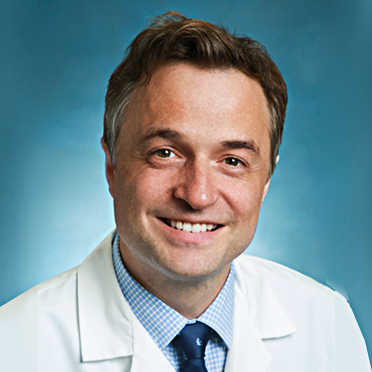
Erwin Grussie, MD
Medical Oncologist, Roy and Patricia Disney Family Cancer Center |
The original 2024 article also highlighted Ora Gordon, MD, and the role of cancer genetics and research across Providence’s regional cancer programs. These contributions reflect the importance of integrating clinical care with ongoing investigation while distinguishing established treatments from emerging screening technologies.
Coordinated Breast and Kidney Cancer Care at Saint John’s
Cristina Torres’ story illustrates how two independent cancers can emerge during one period of medical care and why each diagnosis requires careful evaluation. Through the coordinated efforts of Dr. Crystal Fancher, Dr. Ramkishen Narayanan, and their colleagues in Burbank and Santa Monica, Cristina received breast-conserving treatment for DCIS and kidney-preserving surgery for localized renal cell carcinoma. Her experience also reflects the reassurance patients can gain from understanding their diagnoses and having physicians who communicate across specialties.
Patients can learn more about the Margie Petersen Breast Center, explore Kidney Cancer Evaluation and Treatment, and review available Cancer Support Services. Anyone receiving more than one suspicious finding or cancer diagnosis should discuss appropriate diagnostic evaluation and coordinated treatment planning with their medical team.
Sources & Further Reading
- Synchronous and Metachronous Multiple Primary Malignancies: Review of Associated Risk Factors
- Breast Cancer With Synchronous Renal Cell Carcinoma: A Rare Presentation
- Primary Synchronous Malignancies of the Breast and Kidney
- National Cancer Institute — Definition of Synchronous Cancer
- National Cancer Institute — Cancer Screening Tests and Multi-Cancer Detection
- National Cancer Institute — Questions and Answers About Multi-Cancer Detection Tests
- Saint John’s Cancer Institute — Margie Petersen Breast Center
- Saint John’s Cancer Institute — Breast Cancer Surgical Treatments
- Saint John’s Cancer Institute — Radiation Therapy for Breast Cancer
- Saint John’s Cancer Institute — Kidney Cancer
- Saint John’s Cancer Institute — Cancer Support Services