

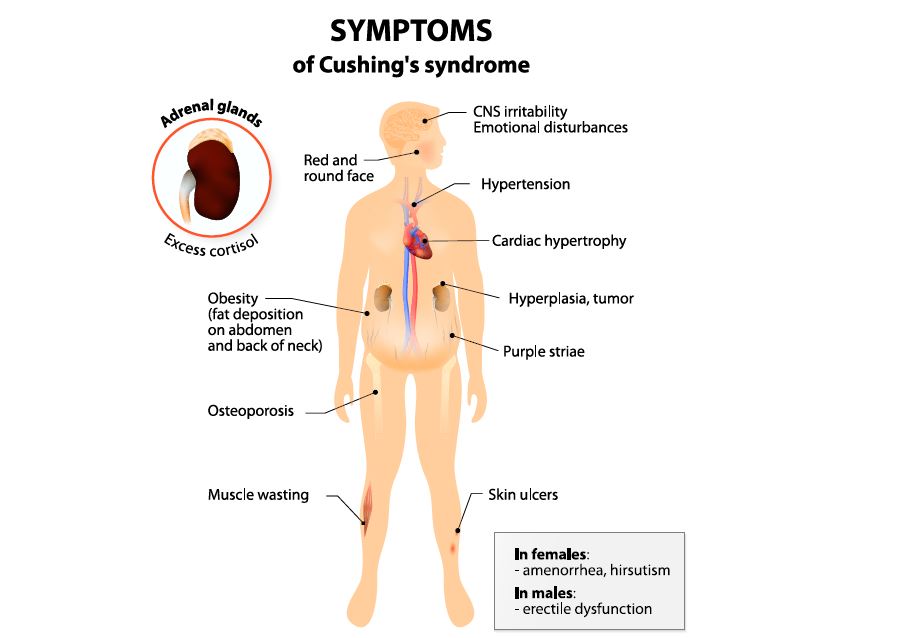
Cortisol is an essential hormone produced by the adrenal glands. It helps regulate blood pressure, blood sugar, metabolism, the immune response, and the body’s response to stress. Cortisol levels naturally change throughout the day, so an isolated high cortisol result does not necessarily mean that you have Cushing’s syndrome.
Cushing’s syndrome is a rare disorder caused by prolonged exposure to excessive cortisol. It can occur when the body produces too much cortisol or, more commonly overall, as a result of prolonged exposure to corticosteroid medicines. Because many of its symptoms can also occur with other common conditions, recognizing the pattern and obtaining the right evaluation are important.
What Is Cushing’s Syndrome?
Cushing’s Syndrome and Cushing’s Disease Are Not the Same Thing
Cushing’s syndrome describes the effects of prolonged exposure to excessive cortisol, regardless of the cause. Cushing’s disease is one specific cause of Cushing’s syndrome: a pituitary tumor that produces too much adrenocorticotropic hormone (ACTH), which stimulates the adrenal glands to produce excess cortisol.
Other forms of endogenous Cushing’s syndrome can result from an adrenal tumor or from an ACTH-producing tumor elsewhere in the body. Cushing’s syndrome can also be caused by long-term treatment with glucocorticoid or corticosteroid medicines.
Why Cortisol Matters
Cortisol is necessary for normal health. Problems occur when tissues are exposed to too much cortisol for too long. Prolonged cortisol excess can affect muscle and bone, blood pressure, blood sugar, cardiovascular health, mood, sleep, and other body systems.
What Causes Cushing’s Syndrome?
Long-Term Corticosteroid Use
Long-term use of glucocorticoid medicines is the most common overall cause of Cushing’s syndrome. These medicines may be prescribed for conditions such as asthma, inflammatory or autoimmune disorders, and after organ transplantation. The risk depends on factors such as the medicine, dose, route of administration, and duration of treatment.
If you take a corticosteroid regularly, do not stop it suddenly on your own. Your clinician can determine whether the dose can be reduced or whether another treatment is appropriate and can guide a safe taper when needed.
Pituitary Tumors: Cushing’s Disease
A pituitary tumor can produce excess ACTH, causing the adrenal glands to make too much cortisol. This form of Cushing’s syndrome is called Cushing’s disease. Most pituitary tumors that cause Cushing’s disease are not cancerous.
Adrenal Tumors
Some adrenal tumors produce cortisol directly. These tumors may be benign or, much less commonly, malignant. Other adrenal disorders can also cause excess cortisol production. Determining whether the source is adrenal is an important part of the diagnostic process.
Ectopic ACTH Production
Some tumors outside the pituitary can produce ACTH, causing the adrenal glands to make excess cortisol. This is known as ectopic ACTH syndrome. The source may be located in the lungs or another part of the body, and the underlying tumor may be benign or malignant.
What Are the Signs and Symptoms of Cushing’s Syndrome?
The signs of Cushing’s syndrome can develop gradually, and not everyone has the same combination of symptoms. Some features are more suggestive of cortisol excess than others, particularly when several develop or become progressively more pronounced.
- Weight gain, particularly around the abdomen and upper body
- Thinning arms and legs or muscle weakness
- A rounded face
- Increased fat at the base of the neck or between the shoulders
- Easy bruising or thinning skin
- Wide reddish-purple stretch marks, particularly on the abdomen, hips, breasts, or thighs
- High blood pressure
- Elevated blood sugar or diabetes
- Bone loss or osteoporosis
- Menstrual changes or reduced fertility
- Excess facial or body hair in some women
- Mood changes, depression, anxiety, or difficulty concentrating
Many of these symptoms can occur for reasons unrelated to Cushing’s syndrome. Their presence alone does not establish the diagnosis. An endocrinologist may be more likely to consider testing when several features occur together, progress over time, or appear at an unusual age.
How Is Cushing’s Syndrome Diagnosed?
A High Cortisol Result Is Not Enough to Diagnose Cushing’s Syndrome
Cortisol follows a daily rhythm and can be affected by medications, illness, sleep patterns, and other factors. For this reason, a single random blood cortisol measurement is not a recommended screening test for Cushing’s syndrome.
Before testing, clinicians should review medications carefully, including oral, injected, inhaled, topical, and other forms of glucocorticoids, because medication exposure can cause Cushing’s syndrome and can also affect test interpretation.
Tests Used to Evaluate Cortisol Excess
Depending on the patient and clinical situation, an endocrinologist may use one or more established tests to evaluate cortisol production, including:
- 24-hour urinary free cortisol testing
- Late-night salivary cortisol testing
- A 1-mg overnight dexamethasone suppression test
An abnormal screening result does not by itself establish the diagnosis. Because no single test is perfect, additional testing may be needed to confirm or exclude Cushing’s syndrome.
Finding the Source of Excess Cortisol
Once Cushing’s syndrome has been confirmed, additional testing can help determine whether excess cortisol is driven by ACTH from the pituitary or another tumor, or by cortisol production from the adrenal glands. Blood ACTH testing and targeted imaging may be used as part of this process. In selected cases, specialized testing may be needed to distinguish a pituitary source from an ectopic ACTH source.
How Is Cushing’s Syndrome Treated?
Treatment depends on the underlying source of the cortisol excess. The goal is to control or eliminate the source of excess cortisol and address the health problems that prolonged cortisol exposure may cause.
Pituitary Cushing’s Disease
For Cushing’s disease caused by a pituitary tumor, surgery to remove the tumor is generally the first-line treatment when it is appropriate. If the disease persists or surgery is not possible, other treatments may include additional pituitary surgery, radiation therapy, medication, or, in selected circumstances, removal of both adrenal glands.
Adrenal Cushing’s Syndrome
When an adrenal tumor is responsible for cortisol excess, surgery to remove the affected adrenal gland may be recommended, depending on the tumor and the patient’s circumstances. The appropriate surgical approach is determined by the tumor’s size, location, imaging characteristics, hormone production, and other clinical factors.
Learn more about adrenalectomy at Saint John’s Cancer Institute.
Ectopic ACTH Syndrome
When an ACTH-producing tumor outside the pituitary is identified, treatment is directed at that tumor when possible. Depending on the tumor and whether it has spread, treatment may include surgery, cancer-directed therapy, medication to control cortisol, or a combination of approaches.
Medication-Related Cushing’s Syndrome
When corticosteroid medication is the cause, treatment focuses on safely reducing the exposure when medically appropriate while continuing to manage the condition for which the medication was prescribed. A clinician should guide any dose reduction or change in therapy.
What Can You Expect After Treatment?
Recovery from Cushing’s syndrome can take time. The body’s normal cortisol-regulating system may remain suppressed after prolonged cortisol excess has been treated, and some patients temporarily need glucocorticoid replacement while normal adrenal function recovers.
Some symptoms improve relatively quickly, while others—including changes in muscle strength, bone health, body composition, and metabolic health—may take considerably longer. Treatment of conditions associated with cortisol excess, such as high blood pressure, diabetes, osteoporosis, and cardiovascular risk, remains important during recovery.
Long-term follow-up is also important because Cushing’s syndrome can recur depending on its cause and treatment. Follow-up plans are individualized and may include hormone testing, imaging, and monitoring of related health conditions.
When Should You Talk With an Endocrinologist?
Cushing’s syndrome is uncommon, and many of its individual symptoms are common in people who do not have the disorder. However, an evaluation may be appropriate when multiple characteristic features develop together, symptoms are progressive, or there is a known adrenal or pituitary abnormality.
If you have an abnormal cortisol test, take long-term corticosteroid medication, or have several symptoms that concern you, an endocrinologist can determine whether further testing is appropriate. The goal is not simply to find a high cortisol number, but to determine whether cortisol regulation is abnormal and, if so, why.
Learn more about Cushing’s Syndrome at Saint John’s Cancer Institute.
Explore the Center for Endocrine Tumors and Disorders at Saint John’s Cancer Institute.
Sources & Further Reading
- National Institute of Diabetes and Digestive and Kidney Diseases — Cushing’s Syndrome
- Endocrine Society — Diagnosis of Cushing’s Syndrome
- Endocrine Society — Treatment of Cushing’s Syndrome