

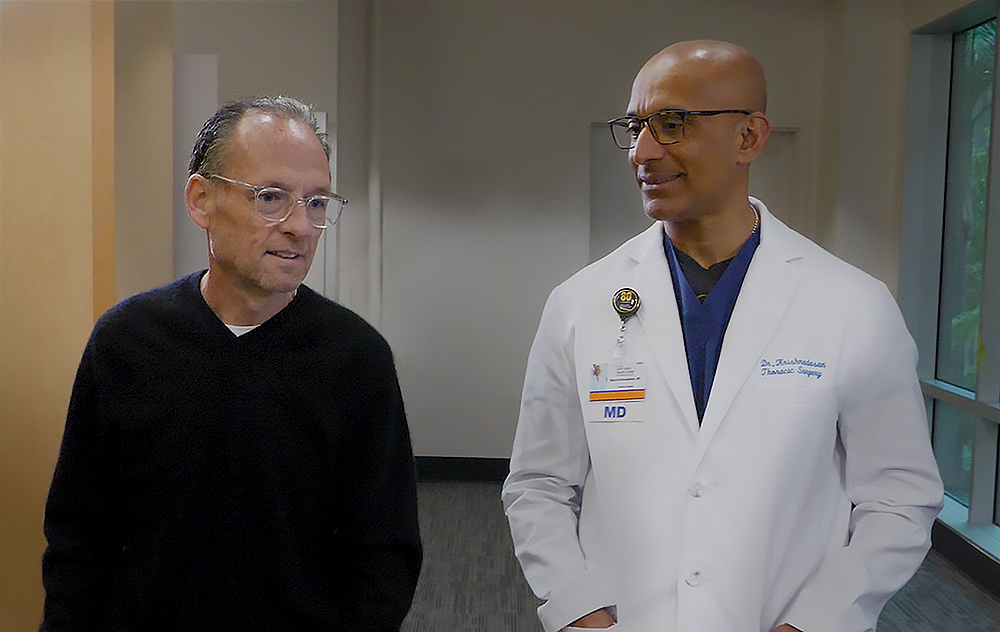
What Is It Like to Have Esophageal Cancer?
Jack’s challenge with swallowing food progressively worsened, causing him immense discomfort; acid reflux made it unbearable at times. He attempted to schedule an endoscopy as soon as possible at a hospital other than Saint John’s. However, the appointment became an endeavor met with undesirable delays. Unbeknownst to Jack, the trouble he had swallowing was due to a sizable tumor in his esophagus.
Unhappy with the prospect of waiting a month or more to understand why he was unable to swallow, Jack was referred to Saint John’s Health Center by a friend who was knowledgeable about medicine and physicians. At Providence Saint John’s Health Center in Santa Monica, gastroenterologist Dr. Bedford performed an upper endoscopy. Dr. Bedford then referred Jack to gastrointestinal surgical oncologist Anton Bilchik, MD, Chief of General Surgery at Providence Saint John’s Health Center and a specialist in gastrointestinal and hepatobiliary tumors.
Jack was diagnosed with stage 3 esophageal cancer in late August 2022 at 54 years old. He started chemotherapy a week later in early September. His chemotherapy lasted six weeks, followed by 30 days of radiation and approximately 60 days of rest before surgery. His multidisciplinary team included surgical oncologists Dr. Anton Bilchik and Dr. Baiya Krishnadasan, Dr. Sean Fischer, his medical oncologist, and Dr. Robert Wollman, his radiation oncologist.
At the time of his 2023 interview, Jack was receiving adjuvant immunotherapy with OPDIVO® (nivolumab), administered intravenously as part of a planned one-year course following surgery. Dr. Krishnadasan discussed the role of immunotherapy after chemotherapy, radiation, and surgery in appropriately selected patients. The use of adjuvant immunotherapy depends on the patient’s diagnosis, treatment history, and postoperative findings.
Jack Now Had Two Expert Surgical Oncologists on His Side
Yeah…two experts.
Dr. Baiya Krishnadasan had joined Saint John’s from Seattle, Washington, bringing experience in minimally invasive robotic thoracic surgery and esophagectomy. At the time, he was also involved in training surgeons in the use of the da Vinci Robotic Surgical System.
Jack comments, “I get a phone call from Dr. Bilchik. ‘We’ve been speaking to another surgeon. I’d like him to be part of the team. We’ve been looking to have him join the team for quite some time.’ If Dr. Bilchik feels the need for another surgeon, why in the world would I ever say no?”
Why did Dr. Anton Bilchik recommend Dr. Baiya Krishnadasan to perform the surgery instead of himself? Jack’s surgery was described at the time as the first minimally invasive robot-assisted esophagectomy performed at Saint John’s Health Center. Dr. Krishnadasan performed the operation, removing a tumor measuring approximately 8–10 centimeters.
During the esophagectomy, much of Jack’s esophagus was removed. The remaining stomach was fashioned into a gastric conduit and brought into the chest to restore continuity of the digestive tract. Following surgery, Jack needed to adjust to eating four to six smaller meals a day, a change he did not mind making.
“Jack did very well after a really large and complicated operation,” said Dr. Krishnadasan.
According to Jack, “Traditional esophagectomies are usually 6-9 hours, and [Dr. Krishnadasan’ s] are half that time.”
I understand I was the first… fully robotic esophageal surgery… but it wasn’t just Dr. Krishnadasan; he came with an extensive resume. I attribute to me being alive today to that medical team, and their ability to navigate these tough waters.
– Jack
Eight and a half months after his stage 3 esophageal cancer diagnosis, Jack had begun CrossFit training and was regularly going out to dinner with his wife. Although he still faced restrictions involving both exercise and eating, he was regaining a sense of control over his daily life.
Listen to Jack Recall His Experience With His Multidisciplinary Team
Esophageal Cancer Awareness
“Statistically, sitting here today is a long shot to a certain degree because this disease gets misdiagnosed, or pushed down the road further, and then you’re at a point of no return,” Jack lamented in his testimony.
Jack’s concern reflects the difficulty some patients experience when symptoms are not immediately recognized. Esophageal cancer can develop gradually, and symptoms such as progressive difficulty swallowing may initially be mistaken for more common digestive disorders. The disease is frequently diagnosed after it has extended beyond the earliest stages, although individual outcomes vary considerably.
Jack’s experience reinforces the importance of evaluating persistent or worsening swallowing difficulties rather than allowing symptoms to go unexplained. Current information about symptoms, risk factors, diagnostic testing, and survival statistics is provided in the clinical education section below.
For additional information about esophageal cancer in younger adults, including reflux-related risk factors and symptoms that deserve evaluation, visit our article Esophageal Cancer in Young Adults.
Advice From Jack
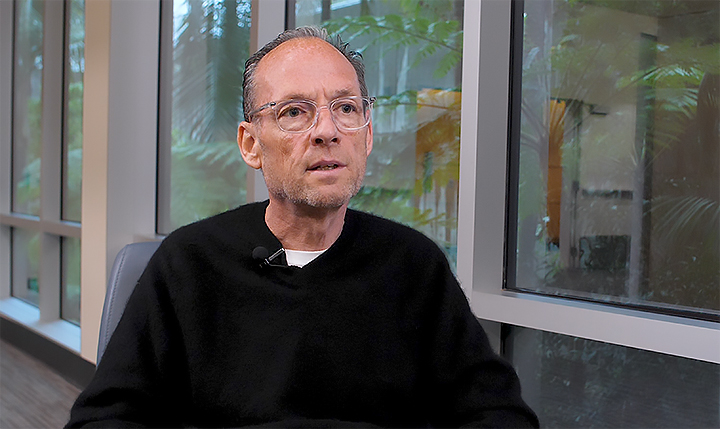
- It’s a mental game.
- I never googled anything after the first time, because I read horrible things.
- There’s nothing I can do, it’s the medicine and the doctors.
- The hospital bed doesn’t care who you are. Whether you’re a billionaire, homeless or somewhere in between, it doesn’t matter.
- When you have cancer, nothing matters except for, how do I get better?
- I was able to find a team, and they jumped on [my health] with a sense of urgency. The other hospital didn’t seem to understand the sense of urgency, or least for scheduling. Here they made me a priority and I attribute that to going to the gym and to going out to dinner with my wife.
- My wife was my light house. There were days that were very dark, and very challenging.
I could read it in their eyes that I was not in the best of shape on day one. Now, I’m in far better shape and their confidence levels are much higher, and my confidence levels is extremely high, so, thank you.
– Jack
—— Updates as of November 2026 for Esophageal Cancer
Understanding Esophageal Cancer: Clinical Considerations
Jack’s experience illustrates one approach to treating locally advanced esophageal cancer. However, not every patient with stage 3 disease receives the same combination of treatments, undergoes the same operation, or experiences the same recovery. Current treatment recommendations depend on the type and location of the cancer, its stage, the patient’s overall health, and the results of diagnostic and molecular testing.
Recognizing Symptoms and Seeking Evaluation
Progressive difficulty swallowing, known as dysphagia, is an important symptom of esophageal cancer. Some patients initially notice that solid foods become difficult to swallow or feel as though food is becoming stuck. Symptoms may progress to difficulty swallowing softer foods or liquids.
Other possible symptoms include painful swallowing, unexplained weight loss, persistent chest discomfort, regurgitation, or anemia associated with bleeding. These symptoms may have noncancerous causes, but persistent or worsening swallowing difficulties warrant prompt medical evaluation.
Upper endoscopy with biopsy is central to diagnosing esophageal cancer. If cancer is identified, imaging and other procedures help determine the extent of the disease and guide treatment planning.
Esophageal Cancer Statistics and Prognosis
The American Cancer Society estimates approximately 22,530 new cases of esophageal cancer and 16,290 deaths from the disease in the United States in 2026. These are population-level annual estimates, not a calculation of how many people diagnosed in 2026 will die from their cancer.
For patients diagnosed between 2015 and 2021, the overall five-year relative survival rate was approximately 22 percent. Survival varied considerably according to how far the cancer had spread at diagnosis, with better outcomes generally observed for localized disease than for cancer that had spread to distant organs.
These statistics describe groups of patients and cannot predict an individual’s outcome. They also reflect treatments received several years earlier. Tumor characteristics, response to treatment, surgical findings, general health, and newer therapies can all influence prognosis.
Treatment for Locally Advanced Esophageal Cancer
Selected patients with locally advanced esophageal cancer may receive chemotherapy and radiation before surgery, an approach known as neoadjuvant chemoradiotherapy. Treatment before surgery may help reduce the tumor’s extent and address cancer cells that are not detectable through imaging.
For patients whose cancer can be removed, esophagectomy may be performed using open, minimally invasive, or robot-assisted techniques. The appropriate surgical approach depends on the tumor, anatomy, previous treatment, overall health, and the experience of the surgical team.
During many esophagectomies, part of the stomach is reshaped into a conduit to replace the removed esophageal segment. This reconstruction allows food to pass through the digestive tract, although patients may need to adjust their eating habits and may experience long-term digestive changes.
Minimally invasive and robot-assisted approaches may offer benefits in selected patients, but operating time, complications, recovery, and long-term outcomes vary. One patient’s experience should not be interpreted as a guarantee of faster surgery or recovery.
When Is Immunotherapy Recommended After Surgery?
Adjuvant immunotherapy is treatment given after surgery to help reduce the risk of cancer recurrence. Nivolumab (Opdivo) is an established option for selected patients with completely resected esophageal or gastroesophageal junction cancer who received neoadjuvant chemoradiotherapy and have residual pathological disease identified after surgery.
The CheckMate 577 clinical trial demonstrated improved disease-free survival with adjuvant nivolumab compared with placebo in this patient population. Treatment may be given for up to one year, depending on tolerance, recurrence, and other clinical considerations.
Not every patient undergoing esophageal cancer surgery is eligible for nivolumab. The decision depends on postoperative pathology, prior treatment, patient health, and current medical guidance. Immunotherapy can also cause side effects, including immune-related complications, which require appropriate monitoring.
Nutrition and Recovery After Esophagectomy
Patients who undergo esophagectomy often need to adjust to smaller, more frequent meals because the reconstructed digestive tract cannot store and process food in exactly the same way as before surgery. Eating slowly, chewing thoroughly, maintaining adequate nutrition, and following individualized dietary guidance may help manage these changes.
Some patients experience reflux, early fullness, weight loss, swallowing difficulties, or changes in bowel function during recovery. Nutritional counseling and follow-up with the surgical and oncology teams can help address ongoing concerns.
Rehabilitation, emotional support, and gradual return to physical activity may also be important. Recovery differs among patients, and strenuous exercise should be resumed according to the surgical team’s recommendations.
Esophageal Cancer Care at Saint John’s Cancer Institute
Jack’s story reflects the importance of recognizing persistent symptoms, receiving a thorough evaluation, and understanding the treatment options available for esophageal cancer. His experience also illustrates the role of coordinated care and the adjustments that can accompany recovery after complex surgery.
Patients seeking information about esophageal cancer can explore our Esophageal Cancer Conditions and Esophageal Cancer Treatment pages. For individualized evaluation, learn more about the care provided by Anton Bilchik, MD, or call 310-449-5206 to contact the GI and Hepatobiliary team.
Sources & Further Reading
- American Cancer Society — Key Statistics for Esophageal Cancer
- American Cancer Society — Esophageal Cancer Survival Rates
- National Cancer Institute — Esophageal Cancer Treatment
- CheckMate 577 — Adjuvant Nivolumab in Resected Esophageal or Gastroesophageal Junction Cancer
- MedlinePlus — Diet and Eating After Esophagectomy